Turkish Translation Services in India: Supporting Export Growth and International Business Operations
As Indian companies explore opportunities in Türkiye’s industrial and commercial markets, effective communication is becoming an important part of managing international business operations. From engineering exports and automotive components to chemicals, textiles and industrial machinery, businesses working across the two markets require accurate documentation to support transactions, technical coordination and supplier relationships.
India’s bilateral trade with Türkiye stood at approximately US$6.88 billion in the financial year 2025–26, according to information published by the Embassy of India in Ankara. Engineering products, automotive components, telecommunications equipment and electrical machinery featured among India’s major exports to the Turkish market. These commercial exchanges create practical requirements for language support across technical, administrative and business functions.
Trade Documentation Requires Language Precision
International trade involves a continuous exchange of information between manufacturers, exporters, importers, distributors and logistics partners. When Indian companies work with Turkish businesses, they may need Turkish-to-English or English-to-Turkish translation for commercial agreements, purchase orders, quotations, invoices, tender documents, product catalogues and corporate correspondence.
The purpose of these documents goes beyond sharing information. They establish product specifications, delivery conditions, commercial responsibilities and other details that business partners must understand correctly. Consistent terminology and careful review can help reduce confusion during negotiations and project execution.
For exporters entering new markets, translated company profiles, product descriptions and websites can also help introduce their offerings to Turkish-speaking customers. The appropriate language and terminology should reflect the intended audience and the purpose of the communication.
Engineering and Manufacturing Drive Technical Requirements
Technical translation is particularly relevant when companies exchange industrial equipment, machinery, electrical components and automotive products. Related documentation may include installation manuals, maintenance instructions, engineering specifications, operating procedures, safety information and quality-control records.
Such materials require more than general language proficiency. Translators must understand specialised terminology, preserve measurements and instructions, and maintain consistency across related documents. Errors in technical content can lead to misunderstandings during installation, servicing or equipment operation.
Businesses can strengthen the translation process by supplying reference documents, approved terminology and relevant product information. Proofreading and technical checks can further improve clarity before documents are delivered to customers, suppliers or operational teams.
Understanding the Turkish Language and Local Context
Turkish has its own grammatical structure, vocabulary and language conventions. Directly translating an English sentence without adapting its structure can produce unnatural or unclear content. Professional Turkish translation therefore requires an understanding of the source material, its intended meaning and the audience who will use it.
This is particularly important for commercial communication, where tone and clarity influence how information is received. Marketing materials may require cultural adaptation, while contracts and technical documents need consistent terminology and precise wording.
Companies preparing websites, digital platforms or product information for the Turkish market may also benefit from localisation. This process adapts content to the target audience while preserving the organisation’s intended message and brand identity.
Official Documents and Business Compliance
Businesses and individuals may require Turkish translation for company records, legal documents, academic certificates, employment records and other administrative paperwork. The requirements depend on the receiving institution, jurisdiction and purpose of the document.
Some official submissions may require certified or sworn translation, a prescribed format or additional authentication. Organisations and applicants should confirm the applicable requirements with the receiving authority before commissioning the work.
Confidentiality is equally important when translation projects involve financial records, commercial agreements, personal documents or proprietary business information. Clear project instructions and suitable document-handling procedures help establish expectations from the outset.
Communication Beyond Written Translation
International projects often require direct interaction between teams. Turkish interpretation may be needed for supplier meetings, factory visits, business negotiations, technical demonstrations and corporate discussions involving Turkish-speaking participants.
Interpretation can help participants exchange information more effectively when they do not share a common language. Depending on the project, companies may also need transcription, subtitling and voice-over services for training materials, presentations, recorded discussions and product demonstrations.
Planning these requirements alongside written translation can help organisations maintain consistent terminology across different communication formats.
Building a Practical Multilingual Workflow
For businesses managing cross-border projects, language support should be considered during the planning stage. Identifying the target audience, document type, technical requirements, delivery schedule and expected quality standards can help establish a suitable process.
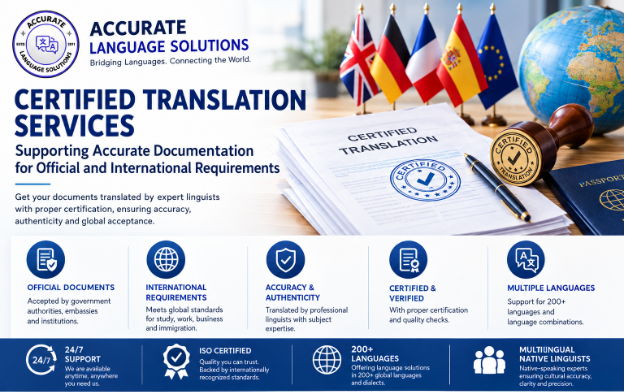
Accurate Language Solutions provides multilingual communication services, including translation, interpretation, transcription and voice-over. Further information is available at https://accuratelangsols.com/.
Turkish Translation Services in India can support companies seeking clearer communication with Turkish-speaking customers, suppliers and business partners. Through accurate documentation, appropriate terminology and context-sensitive language support, organisations can manage international business communication more effectively.
